
Where Old Busted Mugshots May Survive
New York's old busted mugshots do not sit in one database. They scatter. A jail record may remain with a county or city office. It may land in a local archive. Or it may appear as a series description at the New York State Archives. A photo followed its own path. It might sit with a case file, serve as an identity record, or be long gone. That is why an arrest entry and a booking image take separate searches.
Start at the source. That means the agency, sheriff, jail, court, or municipal archive that created the record. Older files often moved. Ask whether they transferred to the State Archives or a county repository. Historical societies and libraries can help too. Their newspapers and indexes often mention arrests. A news image is not the agency's original photograph, though. Give staff the dates, the jurisdiction, and the exact item sought. That way they can identify the right series.
Search New York Archive Catalogs
The State Archives offers several research tools. Finding aids, a catalog, digital collections, name indexes, and archived websites all appear there. None of them promises a scanned record. Start with the official Search for Records page, then follow the catalog or finding aid for the agency and series that match the arrest.
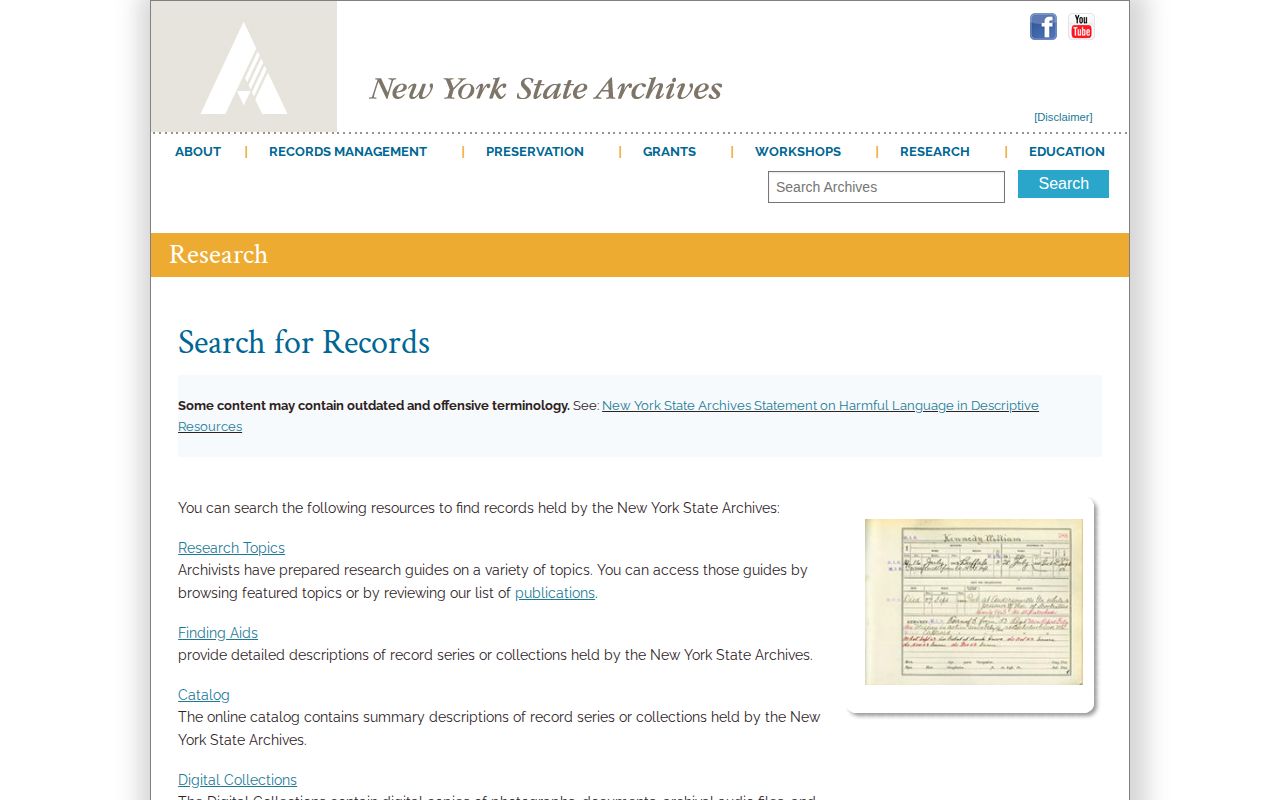
The New York State Archives search interface shows how these resources are arranged. The screen lists research topics, finding aids, the catalog, and digital collections side by side. Try more than one index. Then make your request.
Treat a catalog hit as a lead, nothing more. It does not prove a person's photo sits there. A collection may cover an institution, its staff, or administrative papers. The papers may not amount to a public arrest-photo index. The record group, series title, dates, and access note matter. They tell you which question to ask next.
Useful New York leads include corrections admission registers and custodial-facility photographs. Warren County's jail record book is another. So is the New York City Municipal Archives guide to NYPD Bertillon cards. Each has a different creator. Each has a different scope. A Bertillon card is a historical identification record, not a modern booking photo. A jail register may log custody with no image attached. Read each description before requesting anything.
One State Archives description covers inmate admission registers from Albion State Training School. These books hold personal details, criminal history, and periods of confinement. That can help trace an institutional record. It is not a county arrest log, though. No image is guaranteed. A separate photograph collection documents custodial facilities, residents, and staff. That broad subject range matters. It is why the collection description deserves a careful read before any institutional photograph gets labeled a booking shot.
New York Busted Mugshot Retention
New York schedules its local-government records under LGS-1. The current version took effect April 1, 2022. It replaced earlier schedules. Adoption is not automatic, though, since a county or municipality has to adopt the schedule on its own before it applies. One sheriff may follow LGS-1 while a neighboring city does not. Ask the office which schedule it uses. Also ask whether any series was transferred elsewhere before you treat a retention period as controlling.
For adopting governments, item 1250 makes the prisoner master summary permanent. That summary covers commitments, discharges, and identifying or sentence details. Item 1251 covers a prisoner data file. It can be destroyed 15 years after death or discharge, unless it replaces the permanent master summary. Item 1252 gives a prisoner case record the same 15-year window, though these are class rules only. None sets one online term for mugshots.
The Law Enforcement: Incarceration schedule spells out these classes. It also sets shorter periods for certain housing, supervision, and population records. A photo might sit in a case file, an identity series, a booking system, or its own record series. Nothing there promises public online access. The LGS-1 schedule page names the current schedule and explains its adoption context. That number guides an agency, not the public. It is no promise that a mugshot appears on a public website.
Retention and web persistence are separate things. A county can pull an image from its website yet keep a permanent master record. A vendor copy may outlive the agency's own posting. Long paper files may hold no photo at all.
Requesting New York Archive Records
State Archives Researcher Services can tell you whether a series is held, whether access is limited, and how copies work. Make your question focused. Give the person's full name and any aliases. Add the approximate birth year, the county or agency, the date range, the offense or institution, and the record type. A bare "old mugshot" request is too broad. Staff often need a series, facility, or case clue to search.
- Search the Archives catalog and finding aids for the agency, facility, or collection name. Save the series title, item number, date coverage, and any restriction note.
- Write to Researcher Services with the name, aliases, approximate birth year, county, agency, date range, and type of record. Ask whether a photograph is present and indexed in the series.
- Ask whether the State Archives or a local repository holds the original material, whether it is open, and whether a scan or in-person review is available.
- Request the copy process and current charges before ordering. The Archives says copies may be purchased, but the research found no one fee that applies to every record.
- If the Archives does not hold the record, contact the county clerk, sheriff records officer, municipal archive, or historical society named by the series history.
Remote help is listed at archref@nysed.gov and by phone at 518-474-8955. Ask about the copy process, any charge, and restrictions. Staff can confirm whether an item is closed to the public. A search may turn up a register or file. It may hold no photograph. Some listed collections require a visit in person.
Recent vs Historical Busted Mugshots
A recent booking belongs with the agency holding the person. The state archival catalog is the wrong first stop. New York rosters, feeds, and photo rules vary by county. Start with the right sheriff, city agency, or jail. The New York county directory routes you to those local sources. The statewide records overview explains the layers and the limits.
Older material takes a different path. Identify the arresting agency first. Then find a case or jail-book clue, check the State Archives and local catalogs, and ask which repository holds custody. The archive route will not surface every old mugshot. It is a way to learn whether a record survives and whether it holds a photo that is indexed, open, and copyable.
Warren County and NYC ID Cards
Warren County offers a useful local example. Its Jail Record Book is a historic jail log anyone can view. A separate index speeds up discovery. Search the index, then read the actual book entry. A name match means little until checked against the record itself. The resource speaks only for its own holdings. It does not prove every New York jail posts old booking books or photos.
New York City adds a different lead. The Municipal Archives guide to NYPD Bertillon cards covers police identity cards from the late nineteenth century. Bertillon material is a historical identification series. It is not a modern booking-photo portal. Even so, it gives a researcher a sharper lead than any generic name search, though a guide entry alone does not guarantee the card is digitized or free of restrictions.
These are different custodians and record types. A Warren County jail entry, a New York City identity card, and a State Archives correction-series description are not the same kind of evidence. Check the creator, the date span, the record title, and the access terms first. Only then use an entry to describe an arrest or name a person.
| Archive lead | Known scope | How to search |
|---|---|---|
| New York State Archives | Corrections-related admission registers and custodial-facility photographs; exact coverage varies by collection. | Search finding aids, catalog, and digital collections, then ask Researcher Services to confirm dates and access. |
| Warren County Jail Record Book | A local historical jail record with a separate name index; the linked book and index define its coverage. | Check the index, then verify the matching entry in the record book. |
| NYPD Bertillon cards | Historic police identity cards beginning in the late nineteenth century. | Read the Municipal Archives collection guide and ask about the card series, name indexing, and access. |