
New York Busted Mugshots Start at Booking
A mugshot is an identification photo taken when police book someone into custody. The picture itself starts at booking. Who holds the record depends on the arresting agency and the jail that took the person in. Location matters. In New York, a county booking sits on a different layer than a state-prison profile.
State privacy law adds a wrinkle. Booking photos get different treatment than plain text records. A jail may release a name and booking date but still hold back the photo. The word “busted” points to the arrest itself. It says nothing about how a case ends. A booking entry simply records what officials logged at intake. For the outcome, turn to the court file or a certificate of disposition, and confirm the name and identifiers match the same person.
Rosters can lag or run thin. A same-name hit may belong to someone else entirely. Confirm identity and case status with the agency and the court that hold the record.
New York Busted Mugshot Access Law
New York keeps its open-records rules in Public Officers Law Article 6. FOIL is the short name. Section 89 pulls arrest and booking photographs into the privacy analysis. Under Public Officers Law §89(2)(b)(viii), releasing a law-enforcement record with such a photo counts as an unwarranted invasion of personal privacy unless it serves a specific law-enforcement purpose and no other law blocks it. That is not a blanket ban. Nor is every mugshot automatically public.
Other limits apply. A qualifying favorable termination under Criminal Procedure Law §160.50 seals official records and directs the agency, after notice, to destroy or return certain photographs and copies, subject to statutory exceptions. Other sealing routes use different tests. The Clean Slate framework seals records rather than erasing every copy a private publisher holds. Juvenile and youthful-offender records carry extra privacy protections.
Sealing an official file does not scrub a private website's copy. Some publishers offer free correction or removal routes for specified records. Their rules govern, and rules can change. State law creates no general private-site deletion right. The full legal and correction discussion sits under New York's public mugshot laws.
Note: Public access to an agency file and a private publisher’s copy are separate questions under New York law.
New York Booking Record Fields
New York has no single statewide booking form or photo field. Counties vary. One local roster may show only a name and booking date. Another county offers more detail. Erie County's official inmate list is a useful example. It lists an ICN, name, date of birth, facility, and booking date. It offers no public photo field, charge narrative, bond, or disposition. The gaps matter. A person can be in custody even when the public page says little.
| Record layer or field | What the source may show |
|---|---|
| County roster example | Erie’s list supplies ICN, name, date of birth, facility, and booking date. It is not a full case history. |
| County photo | Some county custody portals display an image on a person’s profile. State photo-disclosure limits and local display policy still apply. |
| DOCCS identification card | The internal photo card can include DIN, name, height, weight, photograph date, sex, race, hair, eyes, date of birth, and NYSID. |
| DOCCS public lookup | The official locator is a text and custody-status search. It does not expose a public photo field or a statewide mugshot gallery. |
| Court record | e-Courts may show a case, appearance, or status. A certificate of disposition or court record is the stronger source for the outcome. |
A DOCCS card is an internal identification record. Nothing guarantees that every field shows up in the public lookup. County rosters differ too. Each vendor, agency, and update cycle shapes what a jail publishes. When you request a copy, name the exact record you want. Then have the custodian flag any field it withholds.
- Booking
- The intake record made after an arrest, with identity and custody details.
- Arraignment
- A court appearance where charges are presented and the judge addresses release conditions.
- Bond
- Money or a secured promise a court may set as a condition of release and return.
- Disposition
- The court’s recorded outcome for a case or charge.
- Sealing
- A legal limit on access to official records; it does not ensure every private copy is erased.
- Expungement
- Erasure of a record under a law that allows it; New York’s Clean Slate framework is described as sealing.
Request New York Busted Mugshot Records
Start local. For a county arrest, contact the sheriff or police agency that made the bust, then confirm which office keeps the booking entry and photo. Every county runs its own records process, so the locality directory is the fastest way to land on the right county site. Avoid statewide asks. Requesting every recent arrest or every face is not a workable description, and it invites both privacy objections and burden pushback.
- Send a written FOIL request to the agency that holds the record. Identify the person, arresting or custodial agency, a narrow date range, and any booking, incident, or other number known to you.
- If seeking a booking photo, explain the specific law-enforcement purpose for disclosure under §89(2)(b)(viii), if one applies, and ask the agency to release any non-exempt portion.
- Ask for an electronic copy where available. The agency must grant, deny in writing with its reason and appeal right, or acknowledge the request with an approximate response date within five business days.
- If denied, use the agency appeal instructions. New York allows an administrative appeal within 30 days, and the agency must decide that appeal within ten business days.
FOIL sets statewide rules. A photo can still be withheld. Counties also answer at their own pace. No single statewide fee or retention period covers booking photographs, so ask the office that holds the record you want. When a record is sealed, the originating agency or court can explain how its order affects the copy.
A state-prison ID photo needs its own DOCCS request. The DOCCS FOIL page gives the electronic filing route and the Records Access Officer contact. Ask for an existing image, not a new one. Include the person's name, DIN or NYSID, date of birth if known, facility, and approximate photo date. Request an electronic copy, plus any non-exempt part the agency can release if the full record is withheld.
- Use the DOCCS Open FOIL route or address the request to its Records Access Officer. Include the person’s full name and DIN or NYSID, plus a date of birth, facility, or approximate photo date when known.
- Describe the item as an existing identification photograph and ask for electronic delivery. FOIL does not require the agency to create an image or search from a vague name.
- Ask the officer to release any segregable part and identify the exemption if a record is withheld. Privacy, security, sealing, or law-enforcement limits may apply.
Note: The five-business-day rule may be an acknowledgement rather than delivery of the requested record.
Finding New York Busted Mugshots Statewide
Where you start depends on custody status. Someone just arrested sits with the booking agency. Others may wait in county jail, state prison, or federal custody. The arresting agency and its location anchor the search. A town bust might involve local police, State Police, transit or campus officers, or a federal agency. And a person released on an appearance ticket may never appear on a county jail roster.
- Identify the likely arresting agency and county. Use that county’s official search, if one exists, and note the page’s update date and what custody status it covers.
- If no person appears, check the official press release, arrest report, or records-request instructions. A missing result can reflect release, delay, a different custodian, or no public roster.
- For a sentenced state prisoner, use the DOCCS locator. Search by DIN or NYSID when known; a name search can be narrowed by birth year. Compare more than one identifier.
- Use New York Courts’ e-Courts for a case or appearance, then confirm the outcome with the court record or certificate of disposition.
- If the event may be federal or immigration-related, use the BOP or ICE custody locator for that separate system. Neither is a New York county mugshot search.
- When a public search is absent or incomplete, ask the agency that created the record through FOIL rather than treating an aggregator as the official file.
Each search ends somewhere different. A new booking can lag before hitting a roster. Release pulls a name off the current-custody screen, yet the agency keeps the booking record. Case outcomes live with the court, and a prison sentence belongs to the DOCCS layer.
New York Busted Mugshots by County
New York publishes no official statewide booking feed. Each county does things its own way. Some run photo-capable custody searches, while others post text-only PDFs, selected arrest reports, vendor portals, apps, or no complete roster at all. The county roll-up spans 61 sibling county pages. Photo-capable examples include Allegany, Cattaraugus, Chemung, Greene, Nassau, Niagara, Schuyler, Steuben, Ulster, and Wayne. A photo may cover only a current inmate profile. It proves nothing about the rest of the roster. The five borough counties work differently. Bronx, Kings, New York, Queens, and Richmond draw on city police, corrections, court, and prosecutor systems instead of five county-sheriff feeds. Elsewhere, a county line alone may not reveal which agency made the arrest. The New York County Directory points to the right locality site, which describes its source type and access path.
Note: A county site can route a search, but the arresting agency remains the source for its original record.
New York Roster and Feed Differences
Counties post on no shared clock. There is no common same-day window. Some agencies run current-custody searches, while others publish weekly, periodic, or selected arrest reports. Those reports are not live feeds. They leave out plenty of arrests. When an agency links an app or VINE, treat it as an alert or status tool, not a photo source. Erie's official PDF is a text roster listing an ICN, name, birth date, facility, and booking date. Cayuga, Columbia, and Essex publish periodic reports. Broome posts selected sheriff releases, and Washington's recent-arrests page may carry agency-supplied photos. So "latest New York arrests" is never one reliable statewide list. Check the local page for its source, update note, custody scope, and photo availability.
| Where to look | Coverage and photo limits | Official? |
|---|---|---|
| County custody portal | Some sheriff-linked searches show current custody and a profile image. The Erie County inmate list is an official text-only example. | Yes, when reached through the county or sheriff. |
| Arrest reports and press releases | Broome, Cayuga, Columbia, Essex, and Washington publish selected material; a report is not a live jail census. | Yes, agency-selected. |
| DOCCS public lookup | Text and custody status for current and certain former people; no public photo search. | Yes. |
| Courts and federal custody | e-Courts verifies case activity; BOP and ICE cover separate federal systems. These tools are not county mugshot feeds. | Yes. |
| Commercial New York pages | Busted Newspaper, Recently Booked, Mugshots.com, and Arrests.org show selective secondary listings that may be stale. | No. |
The Recently Booked New York index gathers county links and a recent-arrest window. Coverage stays incomplete. It is no official roster, and its displayed counts and timing claims can shift. Confirm details with the county agency or court.
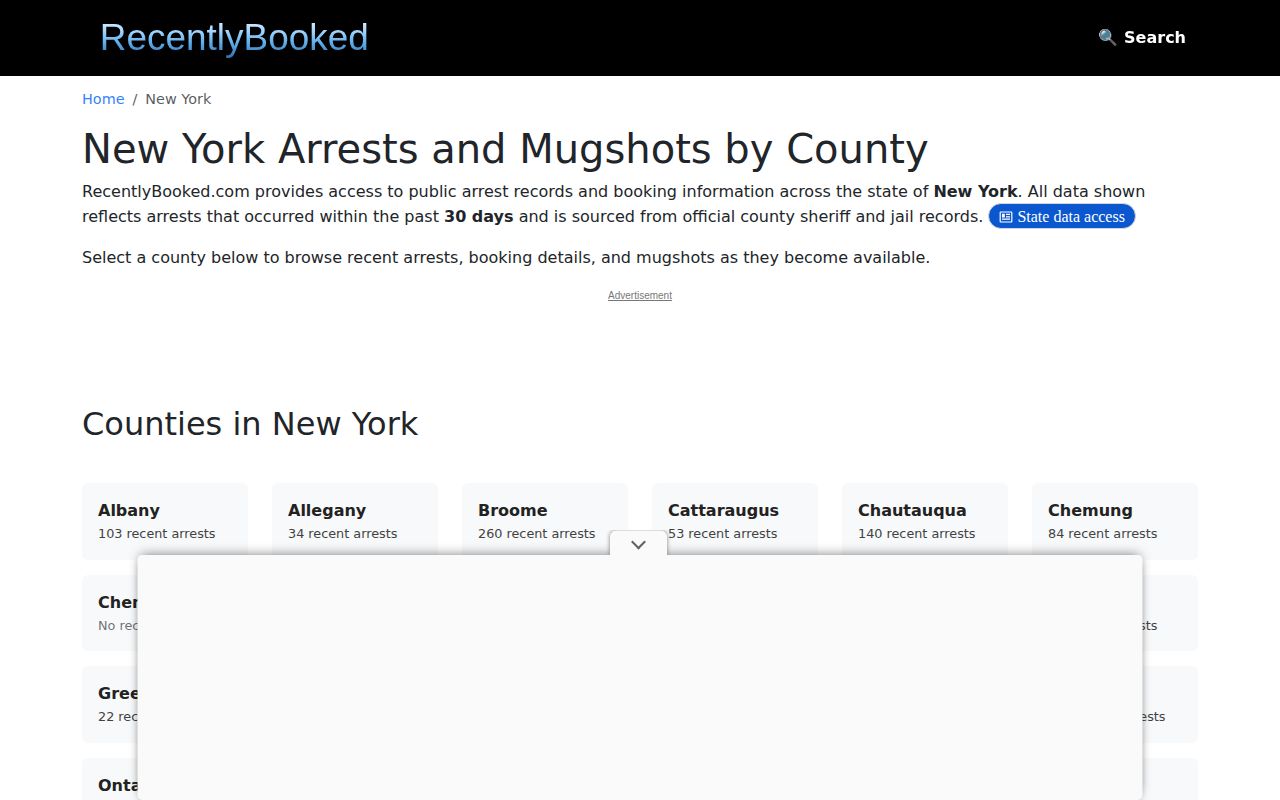
The county tiles are a navigation aid from a commercial source. They prove nothing about county feeds. Use the county's own portal or records unit as the primary record path. Why might a New York roster show no photo? A county can post a text-only list. It can omit photos or show an image only on a current-custody profile. The missing image does not mean no booking photo exists in an agency file.
Note: County apps and VINE links may provide status or alerts without publishing arrest photos.
DOCCS State Offender Search
DOCCS runs New York's state prisons and community supervision. Its public locator is a text and status search. It is no photo gallery. You can search by DIN, NYSID, or name, and a name can be narrowed by birth year. Records change after a transfer, release, return, or correction. Record the query date and compare identifiers carefully. The lookup also covers only a defined slice of current and former incarcerated people. It is not every person ever held in New York. The state says some records stay hidden. Youthful-offender cases and specified set-aside or removed records are examples. Directive 4038 governs internal ID photos and their updates. The public search itself shows no photo field. The official DOCCS search screen presents a text lookup, not an image index.
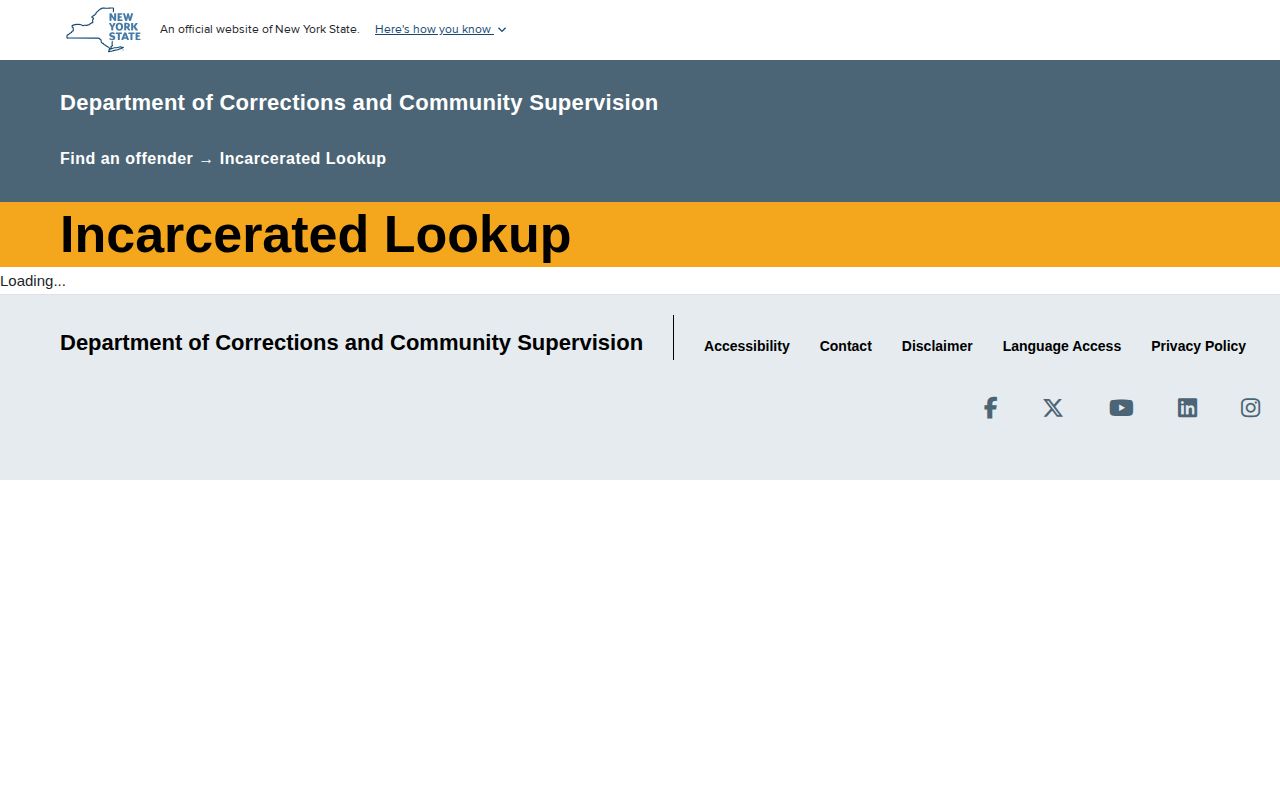
The locator rarely answers the photo question. A targeted FOIL request can seek an existing identification image from DOCCS. County booking photos stay with the local custodian instead.
New York Wanted Lists and Warrant Checks
Wanted lists in New York come from several agencies. State Police run one page. DCJS runs another. Corrections posts profiles tied to alleged supervision violations. Each list serves its own law-enforcement purpose, so none of them adds up to a complete warrant file for the state.
The DCJS list is called "100 Most Wanted." That is a program name, not a fixed headcount. The New York State Police wanted and missing page mixes wanted cases with missing-person and unidentified-person files under one roof. DCJS New York's 100 Most Wanted is separate.
Never approach someone on a wanted list. Call 911 if there is immediate danger. Otherwise, use the tip line the investigating agency names. To learn whether a specific warrant exists, ask the court or agency that issued it, or talk to a lawyer. New York has no single public statewide warrant search, and absence from a wanted list proves nothing either way.
Note: State and federal wanted profiles describe selected cases, not a statewide warrant census or a finding of guilt.
Booked, Released, or Sentenced
A mugshot can sit in different hands. It depends on custody. A county jail roster shows only current inmates, and only where the county posts one. After release, the booking record stays with the arresting or custodial agency, subject to access and sealing rules. State and federal prison searches are separate systems altogether.
| Status | Best starting source | Limit |
|---|---|---|
| Recently arrested or booked locally | Arresting agency, county roster, or selected booking report | Some people are released without jail booking; updates and photo release vary. |
| Released from county custody | Agency booking record or a FOIL request | The person may no longer appear on the current roster; a photo request still faces §89 privacy review. |
| Sentenced to New York state prison | DOCCS public locator for custody status | The public locator is text-based and is not a photo gallery. |
| Federal custody | BOP inmate locator | It provides custody information, not a routine mugshot service. |
| Immigration custody | ICE detainee locator | Immigration custody is not a New York criminal conviction. |
The BOP locator covers federal custody only, reaching back to 1982. It offers no public mugshot gallery, unlike state and local tools.
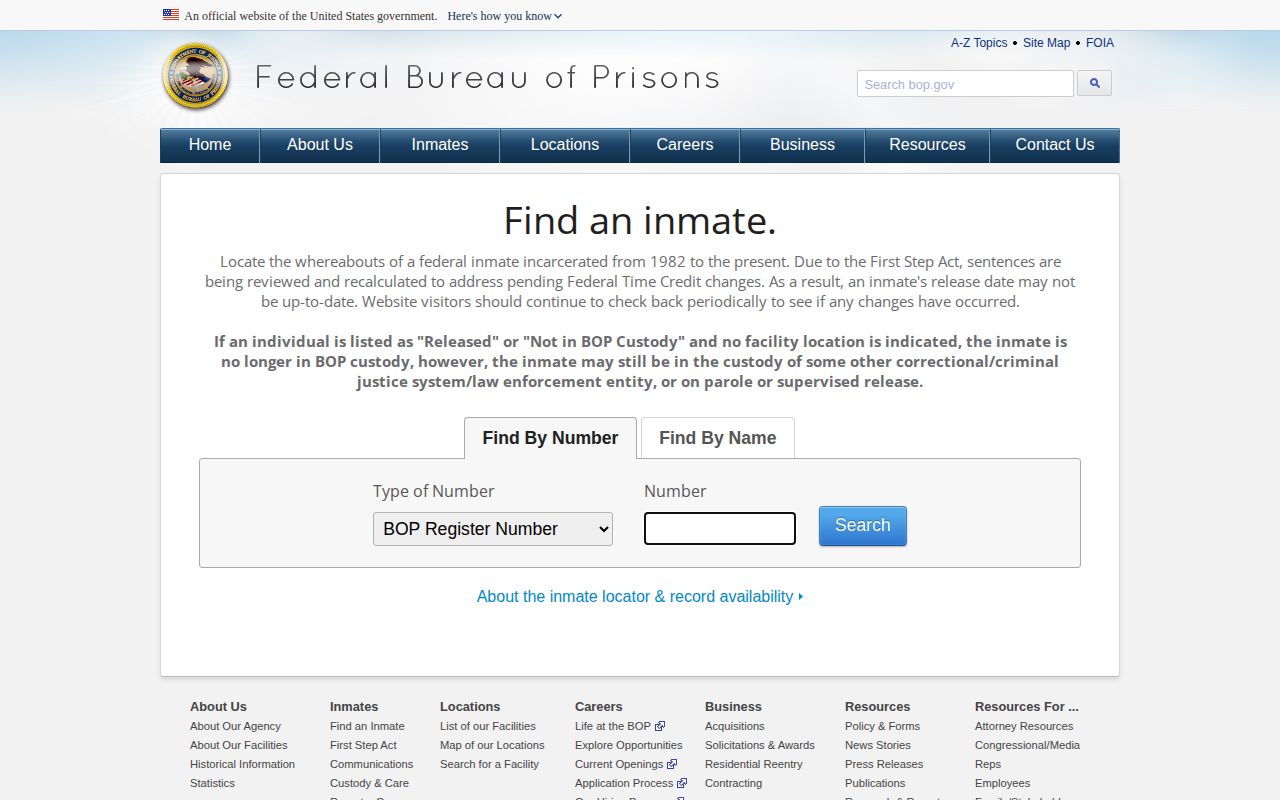
A federal result tells you nothing about the first arrest. It won't name the court either. The docket or the originating agency holds those details.
New York Court and Federal Records
Start with the courts for case facts. The New York Courts e-Courts portal ties into WebCriminal and other case tools. It may show charges, appearances, or case status. It is not a mugshot source. It is not a full criminal-history file either. Shared names can pull up the wrong person, and sealed records stay out of public view. Need to confirm how a case ended? Ask a court clerk or request a certificate of disposition.
Court entries and booking pages often disagree on dates or wording. Compare county, court, docket number, and identity details before trusting a match. For older matters, ask the clerk whether a paper record survives.
Federal custody works differently. The BOP locator reports status only. For real records, use the federal docket or the BOP FOIA process. ICE runs its own locator for immigration custody. Search it by name and birth details or an A-number. A detainer or immigration proceeding is not a state conviction, so describe it accurately. In every case, the agency and court that created a record control access to it.
New York Busted Mugshots on Other Sites
Official county and court sources should come first. Busted Newspaper, Recently Booked, Mugshots.com, and Arrests.org also run New York pages. Their coverage is selective. Results are secondary, and they can be stale, incomplete, or about a different person. Counts and page windows shift, so these sites are not arrest statistics or a custody roster.
The Busted Newspaper New York section links selected counties and warns that its material can be inaccurate or out of date. Recently Booked shows a county index. It also posts a recent-arrest window. Even its claim of official feeds does not make it a state service. Mugshots.com carries broader aggregated and historical material. Arrests.org links only a subset of counties.
Mugshots.zone lists no New York section. It offers no current opt-out route. Treat its root page as no New York source, and if a third-party listing matters, confirm the underlying arrest with the named agency and follow the case through the court.
Where Old New York Records Go
New York's LGS-1 schedule governs local-government records, including law enforcement. It sets permanent and long-retention classes. It sets no universal online mugshot period. A master prisoner summary is a permanent record. Prisoner data and case files may be kept 15 years after death or discharge. They fall under separate items. A booking image can fall into a different series entirely, and a retained file is not guaranteed to be online or public. The NYS Archives incarceration schedule lays out these classes, including the entries for prisoner summaries and case files.
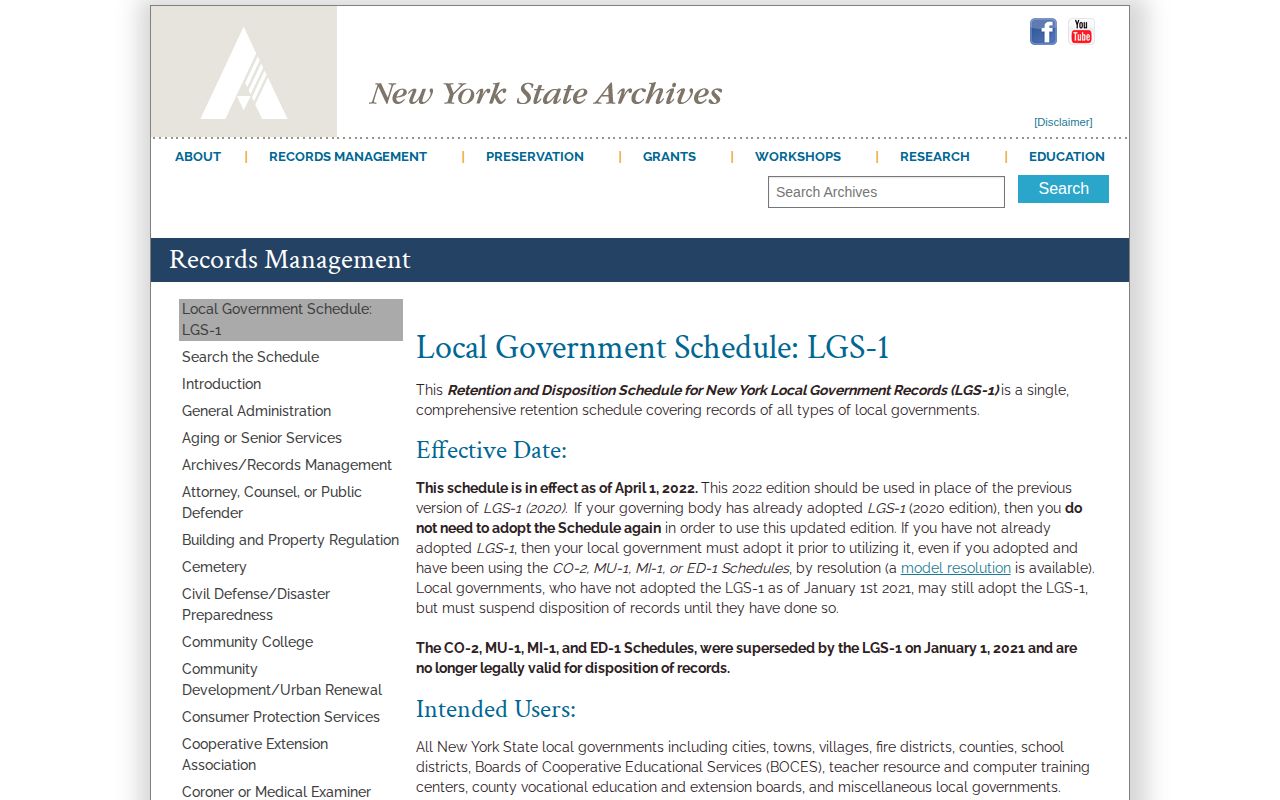
Retention rules say how long an office keeps files. They promise no public photo collection. For historic searches, the State Archives points to catalogs and finding aids, while county and city repositories may hold local material.